Accessing Rivers of Thought - Complete
You are the single thought of life; it is in you, it is the real you. The eternal rivers are inside of you.
Accessing Rivers of Thought
Part I
Chapter I: Promises
"He who believes in Me, as the Scripture has said, out of his heart will flow rivers of living water." - John 7:38
Have you ever wondered about this? We often think we understand what statements mean, but we hear them how someone told us to hear them.
There are some statements, such as this one, that you can consider.
What is really nice about this verse, as opposed to many other verses, is that it is hard to say that it is talking about something other than what it is talking about.
For example, the verse,
"Beware of false prophets, who come to you in
sheep's clothing, but inwardly are ravening wolves."
- Matthew 7:15
This statement leaves much room for interpretation. I can give you any interpretation. I can tell you any type of person is a false prophet.
But this first statement, "Out of his heart will flow rivers of living water," it gives you something to work with.
This clearly refers to something associated with the heart, the chest region.
This statement is called a conditional statement. It gives a condition, a promise. If you do this, then this will happen.
Conditional statements are useful because you can test the condition to see results.
A conditional statement works like this,
"If you do this,
then this will happen."
If it does happen, you know that it is valid and you are applying it correctly.
If you do the if, the condition will be fulfilled, and then the promise will be received.
You can know whether or not it is interpreted correctly based on whether you received the results.
This is how conditional statements work.
Chapter II: Results
So someone comes to you and says, look at this verse,
"He who believes in Me, as the Scripture has said, out of his heart will flow rivers of living water."
Then he tells you what it means.
And what you do is you look at that person, and you ask, is the condition of that statement made true, and how?
The person telling me this, are rivers of living water flowing from his heart?
What do I hear in his voice? What are the works of his hands? What are the products of his mind? What is the quality of his essence? Are rivers of living water flowing out of him and into his world?
The one who knows even a little scripture can look at this and see and reflect,
"Yes, I remember the verse about the person with good fruits coming from them. That a good tree produces good fruit."
So there is the question,
Is the fruit from this person's tree rivers of living water?
That's the first part. Then there's the second part. You think you understand the verse. But the conditional promise still applies to you. So you look, and you ask,
are rivers of living water flowing out from my heart?
Because if they are not, if you believe you have been implementing the work for the condition, and you are not receiving the result,
it means you have misinterpreted the condition.
The result is your proof. This is how objective evidence-based logic is, and one of the reasons Christ liked to speak plainly often in two ways, in conditional statements and indirect statements, repeatedly stating that something is what it is.
In this way Jesus says, "If I am not doing the works of My Father, then do not believe Me. But if I am doing them, even though you do not believe Me, believe the works themselves, so that you may know and understand that the Father is in Me, and I am in the Father.”
This is the way Jesus used logic.
His logic is this:
"I'm doing good work. My father is good. Good things come from good, so then I am good.
If you don't believe me, then believe in the works themselves because they are good."
His logic and evidence is simple: goodness is good.
He understands these words are lost on his audience, so he tells parables to the people instead.
Chapter III: Self-Results-Testing
This kind of self-testing is like when Christ told Matthew,
"Go and learn what this means; I desire Mercy, not sacrifice."
When I read this, I knew I didn't understand it because it made no sense to me. It looked like a riddle. I had yet to learn what it meant. I wasn't putting life into my understanding.
When I finally did, there was only understanding. There is no room for misinterpretation.
God says, I desire mercy. That's it. That's the whole thing. There is no confusion, nothing complex, no riddle. Just a simple statement. That is the desire of God, mercy. That's what he wants. So that's what he says.
It is a complete statement; nothing complex about it.
What does that mean in context?
Well, it means he doesn't want your sacrifice, never did.
Why?
Because his only desire is mercy.
Mercy doesn't want anything from you; it doesn't want sacrifice,
that is not the nature of Mercy.
If I say "I desire mercy", and you bring me sacrifices, your toils and labors and works and deeds,
I'd say to you, "What is wrong with you? I don't want any of this. Who told you to do this? My desire is for mercy, for you to have mercy, I want to give you mercy, I want you to have mercy on yourself so that you can go and live your life.
This is not a special, unique interpretation. The verse isn't a riddle. It's a statement.
"He is a man of weak and timorous character; he has suffered so much and is very good-natured.. I keep wondering why he took offence so suddenly..And I think now that there was a great deal to offend him... and it could not have been otherwise in his position.... But he was too genuinely delighted, and that was mortifying. Ah, Lise, he is a good and truthful man – that's the worst of the whole business..And when he had poured out his heart, he felt ashamed at having shown me his inmost soul like that. So he began to hate me at once. He is one of those awfully sensitive poor people. What had made him feel most ashamed was that he had given in too soon and accepted me as a friend, you see..
This must have been how he came to feel it all so humiliating, and then I made that blunder, a very important one. I suddenly said to him that..I myself would give him as much as he wanted out of my own money. That struck him all at once. Why, he thought, did I put myself forward to help him? You know, Lise, it's awfully hard for a man who has been injured, when other people look at him as though they were his benefactors.... I don't know how to put it, but I have often seen it myself. And I feel like that myself, too.. And though it's so dreadful, it's all for the best. In fact, I believe nothing better could have happened..Though he is proud of himself now, yet even to-day he'll be thinking what a help he has lost. He will think of it more than ever at night, will dream of it, and by to-morrow morning he may be ready to run to me to ask forgiveness. It's just then that I'll appear. 'Here, you are a proud man,' I shall say: 'you have shown it; but now take the money and forgive us!' And then he will take it!"
"Aren't we showing contempt for him, for that poor man – in analyzing his soul like this, as it were, from above, eh? In deciding so certainly that he will take the money?"
"No, Lise, it's not contempt," Alyosha answered, as though he had prepared himself for the question.
"I was thinking of that on the way here.
How can it be contempt when we are all like him, when we are all just the same as he is? For you know we are just the same, no better. If we are better, we should have been just the same in his place.... I don't know about you, Lise, but I consider that I have a sordid soul in many ways, and his soul is not sordid; on the contrary, full of fine feeling.... No, Lise, I have no contempt for him."
Chapter IV: Self-Definition Testing
My base logic and definitions are sound, so I can deconstruct those.
Yes, I believe that I know what Mercy is,
I believe I know what sacrifice is in context – doing things for God that He said to do– or even out of context –actually making sacrifices to God.
I also believe that I understand what the statement "I desire X; I do not desire Y." means.
I believe I understand how basic logic works.
But this is something I ultimately clearly see, hear, and understand,
I comprehend the meaning.
Chapter V: Stories with Soul
What seems to happen is that the mind often hears a verse, imagines possibilities, and then believes that what it imagined is the truth,
that there are meanings extracted that have to do with a narrative.
This is a key to avoiding unreality. Religion always has narratives. The meaning is always connected to a story.
The thing with stories is that we use stories to help us understand meaning. Painting a picture of meaning allows us to see it.
But the picture is not the meaning.
Pictures and narratives are art. They are scaffolding.
The underlying truth, the underlying meaning, is just truth.
This is part of why Christ said,
"This is why I speak to them in parables: ‘Though seeing, they do not see; though hearing, they do not hear or understand.’"
To paraphrase,
'I only speak to you in parables. If I give you direct truth, you'll misunderstand it, misinterpret it.'
What's nice about parables and fables is that you know the narrative isn't real; it's just a container to express the truth.
But the mind, if it hears truth, will go off and create a parable for it. Then, it seems that the story in the parable is reality.
This is a condition in which the father, with understanding, gives his son the narrative. Still, the son doesn't understand the difference between truth and narrative, so he forgets the truth but remembers the narrative.
Maybe stories are data with soul.
Chapter VI: Tasting the Waters
So, do I know what this means?
"He who believes in Me, as the Scripture has said, out of his heart will flow rivers of living water".
Well, the conditional statement is true for me. When I understand this verse, yes, out of my heart flows rivers of living water.
So, this is where the mind's discernment comes into play.
The rivers of living water are there. So now you have to determine, is it the right rivers of living water? Or is it wrong?
This is where most minds will always sense fear because you don't know what you don't know. You can't see the other side; not knowing is darkness, and we fear darkness.
And so now, you must choose to trust or not trust in the unknown to get the results.
So first, you ask, do I believe the scripture? Do I believe the conditional promise is a true promise?
Then, do I trust this person?
Now, you shouldn't just give that trust. You have to taste the water and see if it is good. Is it refreshing? Does it drain you? Does it make you feel that you have to do more? Is that because of the speaker, or is it how your mind hears it?
Okay, so you say, that's too many questions, I don't know. I don't think that much.
So don't. Just consider.
You look at the tree, observe its fruit, and consider it, and work from there.
Here's the consideration to make,
" Every good tree makes good fruit, but a bad tree makes bad fruit. A good tree cannot make bad fruit, nor can a bad tree make good fruit. Every tree that does not bear good fruit is cut down and thrown into the fire."
So you just consider,
is the tree producing the promised results?
So if the answer is no, you don't listen to that person.
If the answer is yes, and you are also not producing the results, then if you want those results, you should find their understanding that you don't currently have.
So, suppose you read this and think that I, who heard many minds without understanding, have some experience with this. In that case, if you believe I may understand what this means, I will share my current knowledge with you.
"He who believes in Me, as the Scripture has said, out of his heart will flow rivers of living water."
Right now, my understanding is that this says,
If you believe in the words I am speaking about, just like the Scripture promised, then rivers of living water will flow out of your heart.
Chapter VIII: Direct Interpretation
I could tell you all the ways I have been told this verse means. But right now, I'll just give my direct understanding.
Ideas are like focuses of thought and beliefs.
I understand the verse's statement is made to be this way, and this is also how I make this claim:
"My results are X. This is what I think about, this is what I focus on, this is what I believe, and these are my results."
"If you think about what I think about, if you focus on what I focus on, if you believe in the ideas that I believe in, these will be your results."
Chapter IX: The Proof
What am I focused on?
I am focused on my Father's concerns.
So, the whole New Testament, especially the Testament of John speaks about the concept that the desires of the Spirit should lead the person.
I won't explain the entire concept of living by your Spirit right here.
But.
Here's the proof I provide for my interpretation.
Claim:
If you think about what I think about, out of your heart will flow rivers of living water.
Why:
Because thoughts are streams. Thoughts of Spirit are rivers of living water.
Notice how you can sense this truth, rather than this idea being a manufactured product of mind. There is something more fundamental here.
If you focus on the Will of Spirit, the mind of Spirit, the intentions of Spirit, the desires of Spirit, the heart of Spirit inside of you,
What happens?
Out of your heart will flow rivers of living water.
Why?
Because you are rivers of living water. The Spirit is you. You've just been distracted.
So this is the best part:
What if my interpretation is wrong? What if my understanding is wrong?
Well, then, I still have two victories.
One, I have an immeasurably meaningful experience,
Two, I'm connected to the real me, and this is fulfillment within itself.
When I encounter someone with a different interpretation,
it's not like my opinion is better; I look at them and ask, is their consciousness connected to the streams of living water, life, thought, and renewal? Is their voice refreshing me? Do I expand when I hear them? Do I get closer to my real self?
If the answer is yes, I will follow them and learn from everything they have as I'm a reasonably logical person. They may be more connected to the rivers than I am.
If the answer is no, I only have to look at them. I see an automation reciting a monologue, usually a reaction to fear of not knowing or of a firm statement with no substance behind it.
Thoughts connected to life have substance in them. This substance is food; this food is meaning.
The mind disconnected from rivers, which is all of us at times, is just words with no meaning, no food, no underlying substance,
It is the structure without the form inside of it.
Sometimes, you can charge words with strong feelings, and there is still no substance behind it.
I am no longer disturbed when I receive a mind's automated answer because it would make no sense for me to become upset at that faculty of a person. For me, to be upset would be the same as if I were upset at a robot for performing its assigned function. There is nothing wrong with the robot; it follows instructions as directed and designed.
But if I follow that robot for too long, what will happen? If I think like the robot, gradually I will become disconnected, and look back, and ask, where did all those rivers and streams go?
As a pragmatist, following minds that refresh my Spirit makes sense.
End of Part I of II.
Part II
Chapter X: Ford Maker
Recently, I came to visit an art gallery in the Ford Building. The word Ford-Maker came to my attention: the one who creates the streams.
Sanskrit: “Ford-maker”) in Jainism, a savior who has succeeded in crossing over life’s stream of rebirths and has made a path for others to follow.
The word tirthankara signifies the founder of a tirtha, which means a fordable passage across the sea of interminable births and deaths (called saṃsāra).
Ford-Makers are also called "Crossing Makers" and "Makers of the River-Crossing".
Does this refer to the same kinds of streams? [See Accessing Rivers of Thought - Part I]
What would a man like Ford have been known for?
Innovation?
What is innovation? What does it mean to be innovative?
Innovation is a word we like in our culture, we use for a kind of thought.
We say,
"This is innovative thought."
"This is innovative thinking."
Innovative thinking is a stream of thought, connected to streams of thought.
If you have understanding, flowing rivers and streams of water are not religious ideas,
this is referring to these very same streams of thought, these very same refreshing thoughts are charged, not with weak beliefs and feelings, but charged with the living waters of life, direct from the Thought of Life itself.
Out of the single thought of life, infinite streams of life abound outwards.
You are the single thought of life; it is in you, it is the real you. The eternal rivers are inside of you.
If you focus on the real you, the real Thought which you are, then You, your real Thought, will flow out of you.
This is the return on that promise: "Out of his heart will flow rivers of living water." [See Accessing Rivers of Thought - Part I]
If you focus on the thought Christ was thinking about, then you get these results.
This writing is a proof of those results. The innovative thought that Christ provided with his focus and his conditional statement inspired this writing.
This writing would not exist if it were not for the inspiration from that conditional statement and the meditation on that Thought that Christ focused on, which is called Spirit,
The underlying Thought of Life.
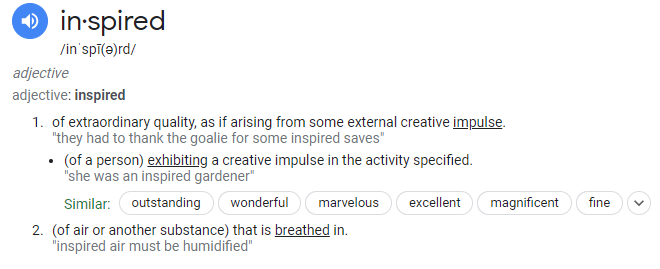
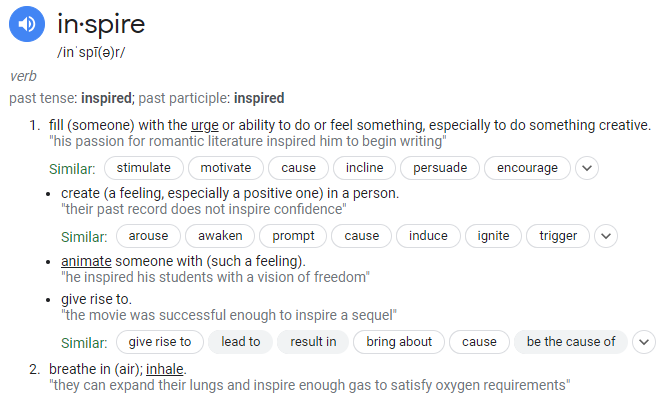
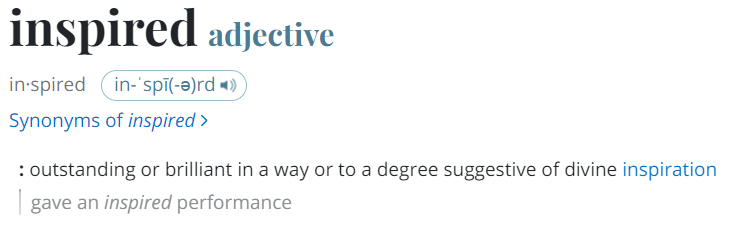
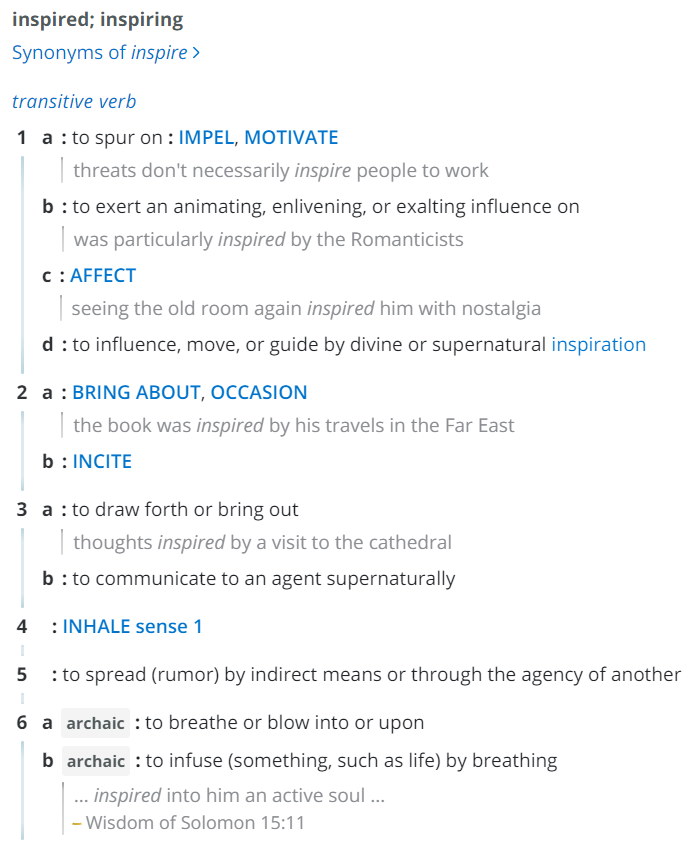
Inspire: to breathe or blow into or upon.
Inspire: to infuse something by breathing.
Why does this matter again?
From Accessing Rivers of Thought Part I:
Because thoughts are streams. Thoughts of Spirit are rivers of living water.
Inspiration is related to these streams. You could say,
- That you could have an inspired stream of thought.
- That an inspiration infused your stream of thought by breathing into it.
- That an inspiration breathed into your thought streams.
Simply the Inspiration of the concept of Spirit is enough to create a change in thought.
The very concept causes the thoughts to focus on something new, to begin thinking about something they were not before.
Focusing thought on new things can cause a drastic change in a person's consciousness. This focus can be called a form of long-term, sustained meditation.
For example, Freedom is a focus you might not have thought of until someone reminded you of it, and a focus on freedom could cause a change in you.
Part III
Chapter XI: The Concerns of The Heart
Something happened
when I started opening back up to Christ’s thinking, believing his words, and following people who have rivers flowing out of their thoughts, out of their voice. I started to remember that "This is how it is."
When the concerns of your Spirit, the thoughts of Spirit, the eternal, universal Spirit inside of you are the dominant concern in your life, the rest fades away, falls away.
You can open entirely to Spirit and passion, and this causes your heart to open and the streams to come out.
This is a long process. It takes seeking and searching and finding for most of us.
But it is how it works. Your deepest, most genuine concerns, they aren’t yours. They are the concerns and the voice of the deeper human consciousness within you.
The normal concerns you think are yours, “Where will I work? What should I buy? What should I wear?” are surface-level, temporary concerns.
These are not the deeper concerns that exist within your heart.
There are concerns in your heart.
If your heart is closed, you will only become aware of these concerns momentarily.
If you do not live with the concerns of your deeper true self in mind, then you will not be concerned with human suffering, not daily.
But if you see a person kicked by a crowd and bleeding, this causes a revealing of your deeper concerns, the deeper concerns that are in the heart. You will realize in this moment that the things you thought you cared about are not the real you,
that the real you is inside your heart, and it has beliefs, concerns, intentions, wishes, and desires.
When the heart awakens, it has the universal desires of life within it.
What is inside your heart wants to be true, wants to be Seen, wants to have joy, wants to love, this is the real you.
Chapter XII: Real Concern
When confronted with unimaginable human cruelty, the real self is revealed.
How do you get there in a less painful circumstance than by accidentally witnessing cruelty?
Christ gives the method, but it is only if one can hear it.
"You must love the Lord your God with all of your heart, mind, soul, and strength."
This verse is not a command. This verse is an instruction manual.
This instruction manual is how to get from point A to point B.
Point A is: The concerns of your limited self, the fear of others, the repression of your expression.
Point B is, Your real concerns, your fear for others, and the expression of your expression.
The way to do this is:
- you weaken your limited mind,
- and you strengthen the desires of your spirit, your higher and deeper mind.
This is similar to a concept the modern one says,
“Stay Hungry."
This hunger refers to a hunger of soul, a growing desire for more.
Instead of just growing the desire for more, intentionally grow the desire to love the Lord Your God with everything.
The Lord Your God is the king of kings, the idea above all your other ideas, the love above all your other loves, it is your highest destiny, your highest truth, it’s your Spirit, the eternal and infinite life that exists inside of you.
If you can be aware of Spirit when you see it–and remember it,
from there, you can create a hunger for Spirit. Over time, that hunger will push you over the edge of your mind’s believed limitations and overtake you.
Chapter XIII: Driving Force
This is what they did not tell me about choosing the light.
They told me,
“If you convert to this religion, and say these words, you’ll be set free.”
They told me that
"this was the light and that it would set me free."*
While there are initiatory
Tending or serving to initiate
experiences on this path, of which a single experience can change a human life forever,
it did not set me free.
It is the more total that the light becomes your driving force and desire which sets you free.
In the pursuit of the passion for the Spirit, you are rising, not falling.
It’s not that you "destroyed your flesh".
It’s not that you stopped doing bad things you wanted to do.
It’s that you have become full of The Spirit that lives in you, and gained the will to do the will of the Spirit,
your deeper will,
your real will,
the way the deepest part of you really wishes you lived, not the way you think you wish to live.
It's not that you gain the power to stop doing bad things, it's that when Spirit is the dominant force in your psyche, you no longer want to do what you once did.
This freedom is possible.
Chapter XIV - Is it worth it?
Is it worth it?
Well, you have got to weigh the costs.
I am now far enough onto the path that I can see that, yes,
- it’s a better experience of life,
- it’s less suffering,
but leaders in the space are telling us the benefits without the costs.
Perhaps it is because they know there is already enough fear in the world, they know they don’t need to create more fear, but should be persuasive in their argument.
But. The pursuit of Spirit not costless. The Life of Spirit is freedom, but freedom does have a price.
The return value is that you get to be real, you get to be who you were meant to be, and do the things you were meant to do. There are costs.
They say, Choose Compassion, it’s all good.
They say, Choose Love, it’s all good.
Well, I choose these things, but I make no claim that it’s all good.
I’m far enough along to see that if you open your heart to compassion,
if you open your heart to love,
then you also open your heart to everything.
You take on the whole thing.
Why? Because opening your heart is a metaphor for increasing your sensitivity to contextual information.
For example,
learning how to be open to sorrows without that sorrow driving you to despair.
Sorrow is a part of this package. It's no wonder that mankind keeps its heart closed.
Chapter XV - One Door
There is only one door to your heart.
There is no other door.
There is one sensitivity to increase the dial of.
If you increase the dial of your sensitivity, it is increased across the board.
The following verse is what is being talked about here.
You cannot hear this if you hear this with your mind, you can only hear this if you choose to have understanding.
You cannot think you know what this means, you cannot think you have heard it correctly from your world,
you have to understand what it means, to know what it means.
“I am the door of the sheep.
All who ever came before Me are thieves and robbers, but the sheep did not hear them. I am the door. If anyone enters by me, he will be saved and will go in and out and find pasture.”
There is only one door to your heart.
If you “close your heart”, all that means is you have chosen to desensitize and look away from painful things. It’s painful to live with a closed heart. It’s more painful to live with an open heart, but life also feels so much better.
Rather than dead in pain, it is better to be alive and in pain.
Final Chapter: Investment.
After writing this,
a man said to me, "God bless you." with a sincere and humble heart.
Then, timidly, he apologized under his breath.
He said,
"I'm sorry. I didn't mean to push my religion on you."
Which should he have done?
Should he have not said "God bless you", in his earnest wish to me,
in order to be appropriate and not offend me?
Which is the right choice?
This is the beginning of the concept of true religion.
The author's claim is that the correct choice is always the one that is true and honest and coming from the heart.
That does not mean that anyone is going to agree with you.
Not one person on earth might agree with you.
Except you!
You can agree with you.
That is your real choice. It's the only choice you really have.
You can become Judas, and betray your heart, your truth, for a few dollars.
Then, you'd look back at the money in your hand, and what will you do then?
You have sold yourself out, and you cannot buy that back.
Or, you can commit to choose to agree with your heart,
as Jesus expressed his heart for the world.
If a truth is not true in your heart, then it is a lie to you.
We are afraid of this as a culture, deeply, deeply afraid of this.
We’re afraid of not being right according to the current times.
This is the most dangerous fear that exists.
The fear of the times is the why fear is the absence of love,
fear is the opposite of love,
fear creates disconnection and increases our concern for self-preservation,
while love promotes our connection and increases our concern for group preservation.
To commit to speaking what is true in your heart is also a path to genuinity.
I write that you can commit to your heart because a relationship of trust starts with a commitment.
If you simply say, "I will speak things true to my heart," there is no commitment there. There are many things we say, but then the moment changes. Our thoughts and priorities change.
A commitment is a promise, and trust is built out of the results of that promise.
If the commitment is made and there is no sign of progress,
then the proof is that the person cannot be trusted.
If the commitment is made and shows positive signs of progress,
a relationship is born.
The heart will not open on its own. It will not speak if it is always returned with self-rejection. It will instead choose to never speak, as it keeps receiving negative feedback from its highest authority, you.
Your opinion and feedback is what matters most to the heart.
If a commitment to the heart is created, there can be a cultivation of self-trust.
This is the beginning of the development of what could be called, personal integrity. This is another way to say, learning to be authentic.
It is more difficult to recognize the long term gain of the development of authenticity from present circumstances.
Meditations on perspectives, such as that you only have one life,
and that one day you will die,
makes it easier to focus on these kinds of long term commitments.
From the present moment, fears of negative consequences are enlarged.
From a long-term perspective, one day of negative results is not a large deal.
However, from a long-term perspective, the rejection of one's authenticity in the moment is a very large deal in the story of one's life.
However, this is an investment that has the potential to allow a person to:
- find their voice
and
- find their truth.
Epilogue: The Ending of Accessing Rivers of Thought
Emerson begins his essay with the announcement that an artist has inspired him and why.
This essay, greater than I have ever known, was surely written in a moment of inspiration,
when Emerson recognized the genius of the artist and held it up high and used it to create his text that would later inspire the greatest text ever written.
That's an inspiration trifecta.
The world may have missed this, but The Brothers Karamazov, the greatest book of psychological literature ever written,
is inspired by Emerson.
I know this is so for a certainty because of my study of the gospel.
In the last speech given by the character Father Zosima,
he stretches the truth as far as it will go, beyond the point of common sense to the point of absurdity.
The author does this first with scripture, then with Emerson, as here:
Christ:
"But I tell you not to resist an evil person..
But I tell you, love your enemies and pray for those who persecute you, that you may be sons of your Father in heaven."
Dostoevsky's Interpretation:
"Again, I say, be not proud. Be proud neither to the little nor to the great. Hate not those who reject you, who insult you, who abuse and slander you.
Hate not the atheists, the teachers of evil, the materialists – and I mean not only the good ones – for there are many good ones among them, especially in our day – hate not even the wicked ones."
Emerson:
"to believe that what is true for you in your private heart is true
for all men, — that is genius..Our first thought is rendered back to us by the trumpets of the Last
Judgment."
"that there is a great responsible Thinker and Actor
working wherever a man works..
Where he is, there is nature. He measures
you, and all men, and all events."
"It is alike your
interest, and mine, and all men’s, however long we have dwelt in lies, to live
in truth.
Besides, all persons
have their moments of reason, when they look out into the region of absolute
truth; then will they justify me, and do the same thing."
Dostoevsky's Interpretation:
"When he realises that he is not only worse than others, but that he is responsible to all men for all and everything, for all human sins, national and individual, only then the aim of our seclusion is attained.
For know, dear ones, that every one of us is undoubtedly responsible for all men
– and everything on earth,
not merely through the general sinfulness of creation, but each one personally for all mankind and every individual man."
So we have three philosophical giants, three ingredients necessary to create the strongest message the world has ever known.
- The artist
- Emerson
- Dostoevsky.
Then 4.
Dostoevsky would go on to inspire Einstein, Osho, Jordan Peterson, Nietzsche, some of the most influential of figures who have been known by our time.
That's four levels of inspiration.
Dostoevsky's Final Commentary
Dostoevsky gives his final commentary on his reflection of Emerson's Self-Reliance and the impact it has had on him in this passage.
I do not know if the world recognized this.
Emerson writes, "A great man is coming to eat at my house. I do not wish to please him; I wish that he should wish to please me."
In the quotes I've mentioned above, I haven't even scratched the surface of Dostoevsky's commentary and interpretation of Emerson.
I have now seen what others have missed, The Brothers Karamazov in its majority is a giant commentary on the above quote,
as well as a visualization in every way the author could attempt to portray and imagine what that quote would look like in the real world.
This matters an incredible deal because what Emerson presents is a way for the highest known Ideal to be made real in this world, as well as real freedom.
But Emerson's essay is compact.
The Brothers Karamazov is the bible of Emerson's essay. It attempts to look critically at its flaws, and again, it explores how this would be seen in the world if it were put into practice.
He's actually given the world a gift that doesn't appear to be unwrapped. That real gift is seeing clearly and expressing clearly what real human freedom looks like, even in an oppressed world.
More to come.
Thanks for Reading!